What is a zero-log VPN? And why do you need one?
A Virtual Private Network (VPN) encrypts your traffic so your internet provider cannot see your activity and the websites you visit.
A zero-log VPN additionally guarantees that the VPN company itself will never record, store, or sell your browsing history, what happens with other or free VPNs.
Without a VPN, your Internet Service Provider (ISP) and cellular carrier actively monitor and record every website you visit to build a profitable advertising profile.
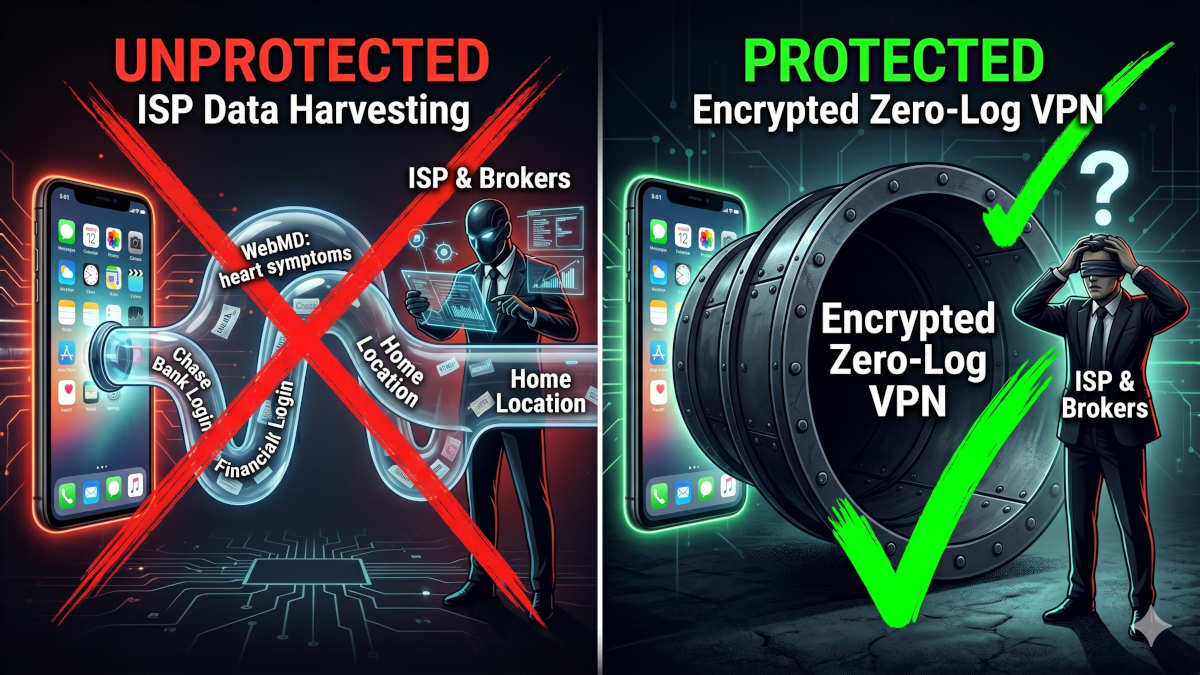
The dangers of using an insecure internet connection
When you connect to the internet, your data is completely exposed to your internet provider because everything you do online passes through their systems.
Internet providers can legally package your browsing metadata and sell it to the $364 billion global data broker market as of early 2026.
This means your medical queries, financial habits, and even your physical location are routinely harvested by corporations you have never even heard of. They also know everything you ask search engines or AI tools.
It is only a matter of time before this data is exposed in one of the hundreds of data breaches occurring globally every month and used to facilitate extremely targeted attacks on your finances or even automated blackmail.
Famous "solutions" that do not solve this or even make it worse for you
Many people try to bypass this surveillance using built-in tools or free services. A company needs to make money - if their service is free, you pay with your personal data for a dangerous illusion of privacy.
- Incognito Mode (Private Browsing) Incognito mode only prevents your web browser from saving your history on your local device. It does absolutely nothing to hide your internet traffic from your router, your employer's Wi-Fi network, or your ISP. It simply means the next person who opens your laptop will not see your search history, but the network still sees everything.
- Free VPN Apps (Hola, Opera "VPN") Running a global network of encrypted servers costs millions of dollars a year. If a VPN app is completely free, they are paying for those servers by logging your personal internet traffic and selling it to the exact data brokers you are trying to avoid. Many free "VPNs" are actually proxy networks that offer weak encryption and route other strangers' traffic through your device's IP address, making it look like you are doing whatever these people do.
- Apple Private Relay (iCloud+). While Apple's Private Relay is a great feature for basic masking, it is strictly limited to the Safari web browser. It does not encrypt the background traffic of other apps running on your iPhone or Mac, leaving much of your daily data exposed to your cellular provider. It also prevents you from choosing your geographic server location, limiting your overall control.
The best VPNs that do not store anything you do
The VPN industry has evolved massively to keep up with aggressive corporate surveillance and sophisticated censorship.
A trustworthy VPN starts at around $3 a month, and two main contenders never log any data - you likely heard these names already somewhere, for a good reason:
NordVPN: Pros and Cons
We are using NordVPN at our office for NordVPN's unmatched speed.
NordVPN’s biggest advantages are its incredible raw speed and ease of use. It easily pushes 800+ Mbps, making it perfect for secure HD video calls and fast, anonymous file transfers.
They are the fastest VPN, but lack a secure ecosystem. For a person or company that already has established secure cloud drives and email, or just wants a VPN, this is the perfect choice.
Note, that the "Basic" plan really is just that - for just $1 more you get their built-in Threat Protection Pro which natively blocks malware and intrusive ads before they even load in your web browser, a password manager, and 1TB cloud storage.
Proton: Pros and Cons
We use Proton Family at home for its complete, secure ecosystem.
Operating under the world's strictest privacy laws in Switzerland, the Proton ecosystem seamlessly integrates your VPN, encrypted email, secure cloud storage and a password manager into one unified suite.
Instead of paying $3 a month for just a VPN, you get an entire privacy ecosystem for you at below $10or for your household or family of up to six people for just below $15 in total a month, which we find much more convenient and also cheaper than having multiple, different subscriptions.
The verdict
If your goal is to watch Netflix in another country or just hide what you are doing, NordVPN basic is your choice.
By investing a little more in the Proton package, you address multiple major privacy issues simultaneously and cover your household or family as well: You get a world-class VPN to blind your internet provider, secure email addresses to stop inbox scanning, secure cloud storage, and an encrypted vault to protect your passwords.