The "Delete me from the Internet" guide - how to scrub your past from the internet and automate deletion of your data
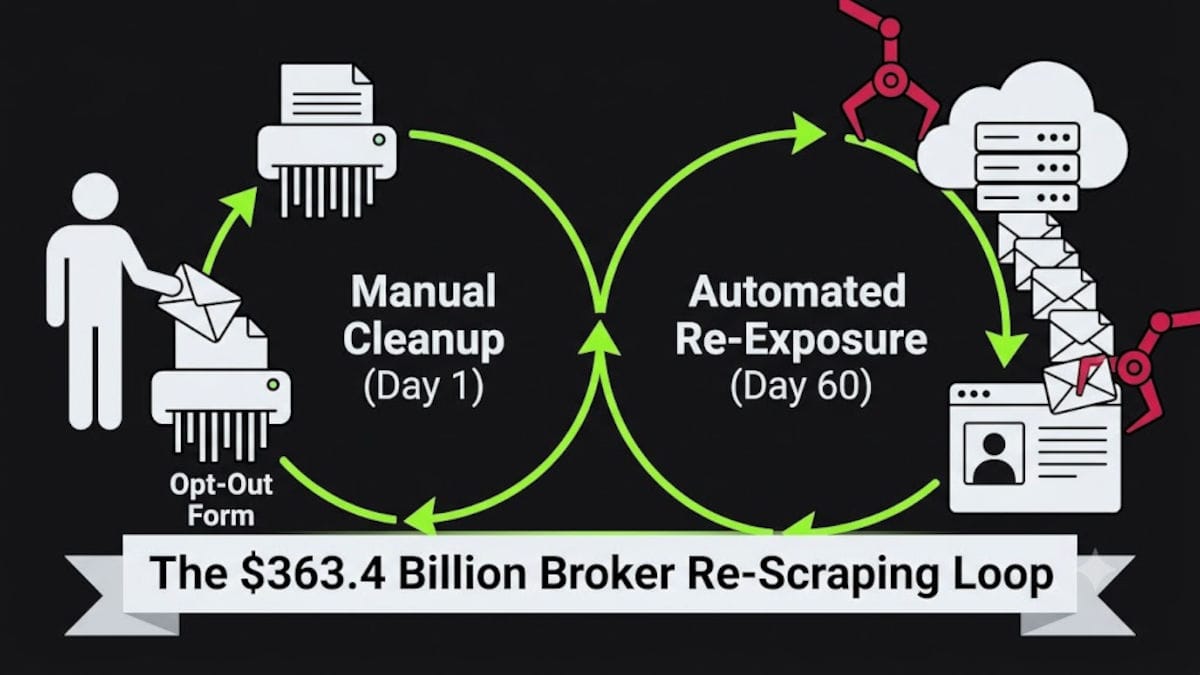
To permanently purge your phone number, home address, and relative data from data brokers, you must stop manual deletion requests and towards continuous, automated data removal and data leakage suppression.
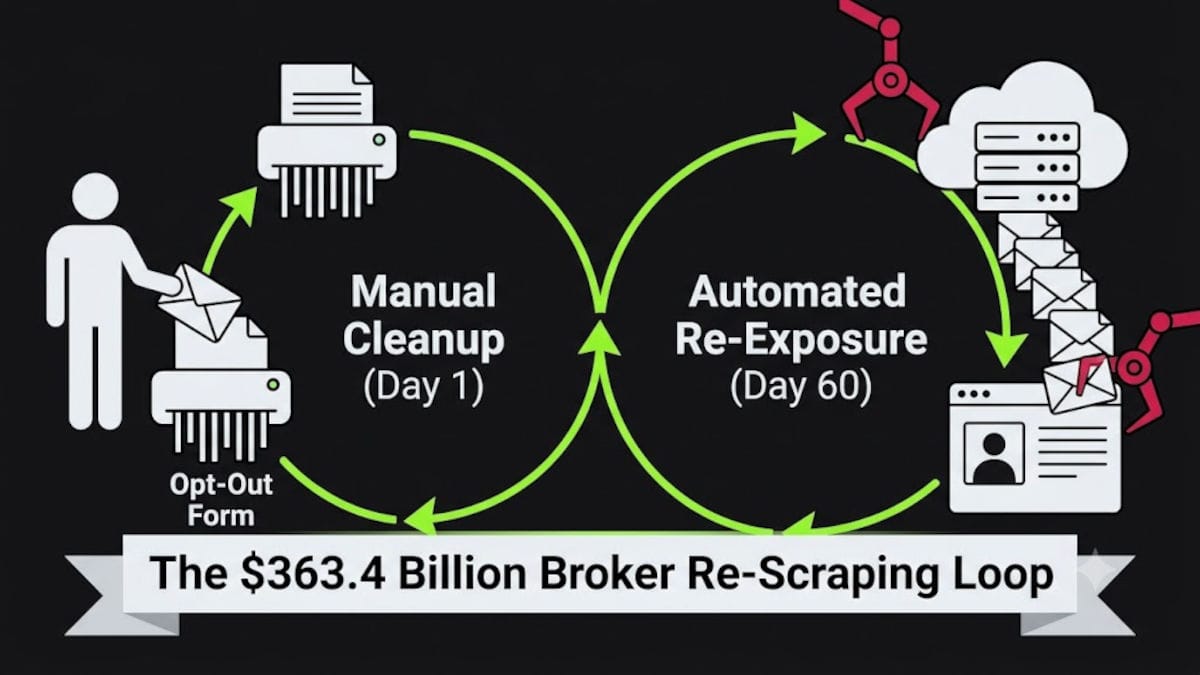
Deleting your personal information from people-search sites manually is a losing battle because data brokers use automated web crawlers to continuously re-scrape public records and republish your profile within 60 to 90 days.
The illusion of one-and-done privacy
The most demoralizing part of manual data removal is that it is never truly finished.
Right now, thousands of data brokers globally feed a massive $370 billion market by trading your personal details. Finding every single registry that contains your home address, phone number, and family connections takes days of exhaustive manual research.
Even worse, some of these corporations intentionally bury their opt-out forms behind confusing website mazes to discourage you from completing the process. After a company honors your initial deletion request, its background systems stay fully automated to maximize information collection.
Unless you constantly monitor every service you use or every piece of data you provide, a single background update, for example, to a county voting registry or a new corporate data leak, will instantly trigger your profile to reappear.
Inside the personal data Re-Exposure Lifecycle
This repeating loop of erasure and sudden reappearance is driven by what security analysts call the Re-Exposure Lifecycle. A broker you successfully forced to delete your profile in January will buy your refreshed data from a completely different company in April.
Data broker networks deploy automated scrapers that continuously scan social media platforms such as Facebook and LinkedIn, as well as databases such as court registries, property records, and retail marketing databases, to extract fresh consumer profiles.
Independent testing reveals that once a manual opt-out is executed, the typical profile is re-harvested and republished online within just 60 to 90 days.
For instance, California’s landmark Delete Act launches its official centralized Data Broker Requests and Opt-Out Platform (DROP) on August 1, 2026, forcing registered data brokers to process consumer deletions at least once every 45 days. While this marks a massive regulatory victory for consumer transparency, it simultaneously confirms that data collection is an aggressive, rolling cycle that state agencies cannot pause for you.
Attempting to replicate this continuous defense manually will trap you in a permanent, exhausting loop of filling out identical corporate opt-out forms every single month.
The real cost of doing nothing
Ignoring the problem is no longer an option in an era when your publicly available records provide the exact ammunition cybercriminals need to bypass your security questions, clone your identity, and compromise your financial accounts.
You cannot afford to leave your digital life exposed, but you also should not have to spend your weekends fighting faceless data corporations one by one.
Why is manual deletion possible but not feasible
Manual deletion of your data is entirely possible, but not really an option.
There are hundreds of data brokers, and understandably, they are not making it easy for you to delete data. It would also be a recurring exercise:
 BOP Authors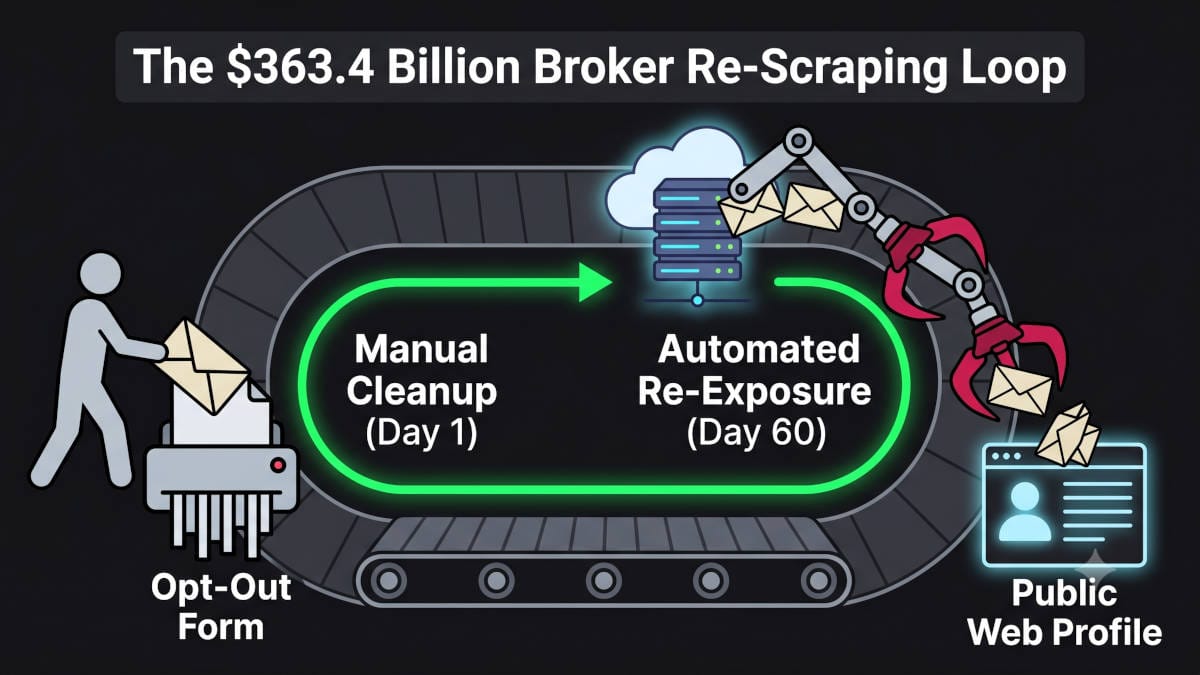
Automating the fight for your private data
To actually force these shadow markets to delete your profile permanently, you need an automated proxy that fights back on your behalf.
Dedicated removal services relentlessly send legally binding deletion demands to hundreds of brokers simultaneously, and automatically challenge them when your data inevitably pops back up.
 BOP Authors
How to scrub your data and eliminate the source of these leaks
Scrub your past from the internet to prevent it from leaking - data scarcity needs to be re-learned in these ages.
What has not been leaked cannot be shared.
 BOP Authors